Chaotic Villains

This is a continuation of a conversation with Aaron that began over social media.

I have been thoroughly schooled in moral relativism, so it is often difficult for me to introduce one-dimensional “Big Bad” villains into my games. Generally, I think this is for the best as it positions players in a way that they have to make hard decisions between two opposing viewpoints. In that vein, I wanted to explore some of the common motivations that tend towards Chaos and then to imagine what a villain who embodies each motivation might look like.

A word of warning, some of this stuff might be X-Card material or otherwise triggering.
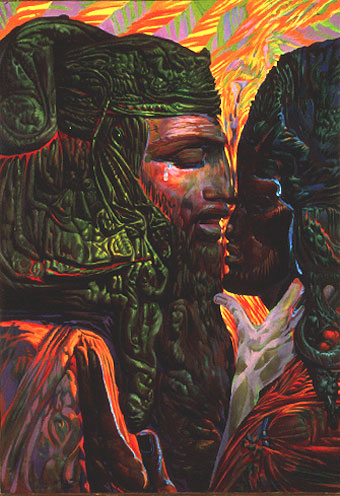

david-and-bathsheba-ii-1985

Sensuality

All know the allure of this force. It can whisper softly in the night, but can also shoot straight as an arrow. Many are willing to temper their otherwise lawful tendencies to indulge in this element of self-indulgent chaos. For example, the king no longer tends to the affairs of state now that he has a new concubine who keeps him away from his throne.

A villain could deplete the treasury to partake in his vice, allow his kingdom to fall into chaos through neglect. A villain could be unsatisfied with simple pleasure and resort to more and more sadistic acts. A villain could seek out specific targets that remind him of his first true love. An army might commit acts of rape upon a conquered populace. A group might be willing to commit other crimes to keep their unconventional practices a secret.

Movies: Dogville (by Lars Von Trier), Lust, Caution (by Ang Lee), Eyes Wide Shut (by Stanley Kubrick)

Stories: King David & Bathsheba, Lancelot & Guinevere, Helen & Paris


Euphoria

Some seek temporary relief by indulging in alchemical or pharmaceutical remedies. Often, this begins innocently enough or by using a substance as prescribed but quickly escalates into a dependency. Once addiction is established, all manner of actions become justified in order to secure another dose.

Villains will hurt innocents and the helpless in order to indulge. Other moralities become secondary to the addiction. The amount of substance required to achieve the same effect increases over time. The villain might act at the behest of another, who controls the supply.

Media: Drugstore Cowboys, Trainspotting, Requiem for a Dream

10_1930Oct4Bujados_800

Adrenaline

The allure of the battle is something very real, some people never feel more alive that when they are engaged in a stressful situation for which they have been prepared. Those who embrace this as a vice would seek out conflict without reason.

This villain might approach be prone to over-reaction, perhaps a lord resorting to violence over trivial matters. This villain might resort to other vices to stimulate the adrenal rush such as dog-fighting, hunting, martial tournaments, dueling, gladiatorial games, torture, etc.

Inspiration: Hurt Locker (film), Robert Baratheon (GoT), The Most Dangerous Game (film)

batten Lion

Nature

The natural world is cruel and uncaring. The strongest, fastest, and most resourceful are rewarded with the spoils of their victory. There is no moralizing in this jungle, the only logic is that of the hunt.  Strength is a moral absolute, victory is black and white. All disputes are resolved with contest. The victor carries neither guilt nor shame.

This villain believes that “law” has perverted the base nature of man. That society has grown away from its tribal animalistic roots. Wards of the state, the old, the ill are all viewed with disdain and the villain will deal with them as one would deal with a pest. This villain does not act with chivalry and tosses aside moral codes, he views morality as a tool of the system. His goal is his own liberation, to act with freedom and without conscience. He also believes that he is acting to rid the world of the cancer that is “lawfulness” with its false moralities.


Autonomy

Hell is other people. These are the people who cannot stand being told what to do, being beholden to another, or being forced to participate. Even if they see the reason for the requirement, they will do the opposite out of spite. They will lash out at any perceived authority, and take even casual offers of advice or suggestion as an unwanted imposition of will.

These villains will reject any compromise. They will use others, but will never willingly subjugate themselves to another. They might work with someone else if they believe that they have the upper hand, or if they believe themselves to be manipulating the other party. They might strive to lord over others, as in a gang or in an autonomous holding. They might seek isolation in wilderness or in an urban expanse such as an empty library or abandoned catacomb. They might have information that they are unwilling to share or responsibility (as by blood) that they are unwilling to fulfill.


I feel confidant that there are more motivations that would lead one towards chaos. It could be fruitful to see what you all think about Chaotic alignment. I skipped some motivations that felt like “low-hanging fruit” and I tried to steer away from echoing the seven deadly sin model. What do your chaotic villains look like? What other sources of media do you think could inspire a chaotic villain?
Running One Thousand Dead Babies w/ 5e

I statted up some 5e dudes to use w/ One Thousand Dead Babies by Zzarchov Kowolski


Brigand      HP 11, AC 12, Avg. Stats (10).
25xp         Shortsword (+3 d6+1), Light Crossbow (+3 d8+1)

Cultist      HP 9, AC 12, Avg. Stats (10).
25xp         Shortsword (+3 d6+1),
             Dark Devotion. Advantage on saves vs. charm or fright

Ruffian      HP 16, AC 14, Avg. Stats (12), Perception 11.
100xp.       Multi-Attack. Shortsword (+4 d6+2), Shortbow (+4 d6+2)

Elf Scout    HP 16, AC 13, Dex 16, Nature/Survival +4, Stealth/Perception +6.
100xp        Multi-Attack. Shortsword (+5 d6+3), Shortbow (+5 d6+3)

Wolf         HP 11, AC 13, Dex 15, Stealth +4, Perception 13. Speed 40ft.
50xp         Bite (+4 2d4+2)
             Keen Senses. Advantage on Perception Checks
             Pack Tactics. Advantage on attack rolls if an ally is within 5ft of target.

Beast        HP 26, AC 13, Str & Dex 15, Perception 13.
200xp        Multi-Attack. Bite and Claw (+4 d8+2)
             Pounce – If charge 20ft and hit with claw, DC 13 Str test or prone

Evil MU      HP 22, AC 12, Int 17, Str 8, Perception 11. Spells +5, DC 13.
300xp        Cantrips: Light, Shocking Grasp, Chill Touch
             1st Level (4 slots): Charm Person, Mage Armor, Magic Missile
             2nd Level (3 slots): Hold Person, Misty Step, Darkness

Witch        HP 28, AC 14, Wis 17, Str 8, Perception 14. Spells +5, DC 13.
300xp        Cantrips: Druidcraft, Thorn Whip, Poison Spray
             1st Level (4 slots): Charm Person, Faerie Fire, Fog Cloud
             2nd Level (3 slots): Heat Metal, Spike Growth, Flaming Sphere

Cleric        HP 30, AC 16, Wis 17, Dex 8, Perception 14. Spells +5, DC 13.
300xp         Cantrips: Thaumaturgy, Light, Sacred Flame
              1st Level (4 slots): Bless, Command, Inflict Wounds
              2nd Level (3 slots): Hold Person, Spiritual Weapon, Silence

Evil Knight  HP 52, AC 18, Str/Con 16, History/Religion/Intimidation +5
700xp        Multi-Attack. Greatsword (+5 2d6+3), Heavy Crossbow (+2 d10)
             Dark Devotion. Advantage on saves vs. charm or fright
             Leadership. All allies in LOS get d4 on attack rolls and saves for 1 min.
             Parry (reaction). Add 2 to AC against one melee attack that would hit.

Half-Goat    HP 76, AC 11, Str/Wis 18, Perception 17. Darkvision 60ft.
700xp        Multi-Attack. Spear (+6, d8+4) Gore (+6, d8+4)
             Reckless. Gain advantage on all attacks, all attacks against have Adv.

Symbaroum Names

batten_tomtitot2

Thanks Tore for linking me to a list on names for Symbaroum written in the mother tongue. Also find this as a Google Sheet.

Ambrier, män Ambrier, kvinnor Barbarer, män
Ader Abesina Adelar
Afadir Adso Alomar
Agani Agathara Arastor
Agramai Agathara Arbusal
Akman Agna Arok
Alamei Ala Aroun
Alavan Aledra Ashfaru
Aldamal Alevia Belun
Alesaro Ana Didramon
Alkantor Ana Dvarak
Almagast Anabela Embersind
Almegaster Anadea Erlaber
Aluin Aragina Gadramar
Ansel Aranitra Gadramon
Anselg Ardetta Galarman
Arelo Asmerda Goroun
Argalo Ava Goured
Argasto Belda Haldron
Argoi Belina Haloban
Argolai Berelin Helionor
Arkali Darda Herek
Arkel Deseba Hoska
Arkerio Desidera Karona
Arno Edria Kodamar
Aro Elindra Konarad
Balon Elionara Leonod
Bartho Elmea Lothar
Bartolo Elvea Ludo
Bartolom Esbetha Maiesticar
Baumelo Esmerelda Malkor
Belago Eufrynda Malrek
Belgo Fabia Manvar
Benefo Fekla Meomaar
Beniam Felega Monovar
Beremo Feona Nikanor
Bolgo Gamalga Odaban
Budol Garala Odalbagar
Cornelio Gerda Odar
Dario Gidia Orameo
Dastan Hurela Orondo
Davidos Hurelia Rábaiamon
Dekamedo Illeva Ranomar
Deledo Illoena Razameaman
Demetro Ireba Taran
Dodramos Isedra Tharaban
Dodrian Jela Vikomer
Dolani Jerea Vikomer
Eberon Kadra Yakobor
Edo Karenia Zoltar
Edogai Katia
Edrafin Katrandama Barbarer, kvinnor
Efram Keitara Adela
Efryn Klarana Agdala
Eglio Koldra Agniesha
Elfeno Korinthia Agshela
Emundi Kumuma Aloeta
Enio Kyhara Aroaleta
Eran Landela Barrvalg
Erdaro Lea Bayela
Ero Lesena Efereneya
Erok Lestra Elbla
Eskander Levia Elda
Eumenos Lida Elinara
Faraldo Lindra Elmea
Fenio Losadra Galoma
Flavus Lukresia Girind
Gadramei Lupina Horosa
Galamar Lysindra Karla
Galeno Marbela Karona
Garasto Marka Kora
Geleto Marla Magdala
Gerek Mehira Miesma
Gidjabolgo Melena Oryela
Golonas Melga Saadar
Goncai Merandra Tyrana
Gorakai Mireda Verama
Gormdan Mirela Vikona
Grafoldo Moria Yagaba
Grego Neferena Yahela
Grendol Nodla Yeleta
Haas Ofelya Yerola
Hadaro Ofera
Handelo Ordelia Bortbytingar, män
Harasto Perela Aka
Harulo Petrona Alahara
Hedero Purgida Ardri
Hen-Loan Ragama Eneáno
Herado Ranid Feon
Herakleo Redeira Galfenio
Herdol Reganna Ganderald
Hide Revina Goriol
Hurian Rilia Grimorio
Iakobo Roia Ibliglin
Iasogoi Salindra Kalfu
Idaros Sarli Klagander
Ilantro Sefira Radomaramei
Isokles Selima Sinue
Jakad Senia
Jeseebegai Serafia Bortbytingar, kvinnor
Joab Serela Ardeánmei
Jomilo Shanda Bekora
Junio Solora Danive
Kaglio Sunna Elorinda
Kalio Suria Hinéua
Karasto Tanfalls Kinlegelana
Kargoi Tariella Niha
Karlio Tealia Riamata
Karon Teira Roha
Karstak Tenid Seanua
Keler Tredella Segvilla
Keroldo Tya Sibela
Keros Vania Varaneia
Kerpano Vanoya Yeloéna
Kheltran Variol
Khenad Verola Troll, yngre
Klamando Vidina Abalog
Klamandro Vilga Aka
Klarag Voldara Aroha
Klavman Erula
Korian Svartalfer, män Hibne
Kranke Alfbolg Ogaloum
Kullinan Barra Ogmaka
Kvarek Ederlug Raham
Laguboi Gabba Riomata
Lasifor Garm Skadal
Lenn Godalg Verhar
Leogoi Goltas
Leohan Idelfons Troll, äldre
Malgai Illefons Aravarx
Mallianos Iold Etaxa
Malmedo Ler Gormyx
Manselm Lurks Noxar
Marvalom Mogga Ognyx
Marvello Olf Onrax
Mergai Prosk Rirbax
Milos Rosti Uhux
Morlam Shigg Vouax
Mullando Shuggludd
Myndol Tengel Alver, män
Nefer Tulga Alal-Roak
Nilos Ugtuls Dareol
Odako Ul Dorael-ri
Ogval Ulofin Eloan-eo
Onedar Urfons Elori
Orai Eneánor
Oreago Svartalfer, kvinnor Godrai
Orlan Aa Ka’eroan
Oromal Fenya Kil-Ano
Pegel Fosa Mearoel
Pellio Fura Renn
Peonios Guhula Saran-Ri
Pergalo Harbassas Tel-Keriel
Piromei Hugalea
Pirosander Nigra Alver, kvinnor
Plendel Njegg Adreanea
Radomei Njekka Ahara-vei
Ralgai Tulga Áleia
Ramigal Udelia Eleanea
Rogan Ufa Gaina-Anali
Sandros Ulehalfa Gealóna
Sarfas Wamba Keri-Las
Sarkomal Ydelia Léa-Kin
Sarogai Yla Leiána
Sarvola Yppa Mael-Melian
Seldonio Naelial
Semel Resar Tara-kel
Seralo Arme Teara-Téana
Seraon Bälga
Serex Barske Dvärgar
Sesario Bauta Artak
Sikander Berge Artek
Skanander Bjässe Bolkor
Talk Brute Brana
Tallios Fuling Dobril
Tamilo Grymkäft Dranek
Tamri Kallhamra Dusa
Tandrag Klagga Ella
Tarleo Kluds Fullangra
Taubio Knöle Jarok
Teoman Manaloum Kasimer
Terr Mangold Kertel
Tonsel Ofreden Lazek
Ulde Ogina Margor
Vallomei Omaka Mirek
Valtos Otymple Radmil
Vendal Proppmätt Stana
Venhal Särling Vesnek
Vernam Stalke Vlador
Ynedar Storkräket Yaruk
Styggnacke
Alvtagna, män Sumpa
Arron Svarten
Awan Ukoul
Beo Urbota
Eral Uwulgas
Gaer Vrede
Kael Vyssja
Lo
Mael
Orel
Tham
Tir
Alvtagna, kvinnor
Anga
Beha
Erli
Fera
Inda
Lonam
Una
Undi
Vird

I’m Crawling, but am I in a Sandbox?

25-Clarke--cover-for-Lennox-Robinson-s-plays--1923

I see a lot of people use the term “sandbox” with very different tones. I see it used to describe games that are aimless journeys with no chance at meaningful character development. Alternatively, I see lots of content come out for sandbox adventures. I see sandbox prep as a solution to complaints about “railroad” stories or instances when the GM is strictly controlling the plot.

I have lots of books about Sandboxes, namely:

I am not sure if I know what a “sandbox” really is. It seems like people use it for a lot of different things. If it exists along a spectrum, what is on the other side?

I think that the core concept of a “sandbox” for me is the idea that the GM spends time prepping materials that can be used regardless of what players end up doing.

“Oh you want to go to the tiny settlement that I didn’t actually name instead of the major town that all my plot hooks are pointing you towards? Good thing I am running this sandbox.”

I think that sandbox prep involves writing random tables, npc names, rumors, random adventure hooks, npc’s to meet on the road, or whatever other events, characters, locations, etc. you want to have populating your world. But does sandbox prep have to be random? 

Is the opposite of sandbox prep, then, to read and run a module without considering these other things? How can a point-crawl also be a sandbox?

Aaron Griffin theorized that “all games are sandboxes,” in the sense that there is always an amount of the infinite that is possible. Instead, Aaron postulated that a more useful axis would have GM-driven plot at one end and player-driven plot at the other.

That spectrum makes sense to me, with module or scenario prep being GM-driven prep and sandbox prep allowing for the GM to have content regardless of whatever the players decide to do.

What does sandbox mean to you?


Shadow Scarring

eric-he-shadow24 cropI’ve been thinking about hacking Symbaroum’s Corruption into 5e by introducing the following mechanic to my game. Let me know if you can think of a more simple way to have a similar effect.
Shadow Scarring

All players begin with a Shadow Threshold of 5.

Shadow Damage

Shadow Damage occurs when an adventurer is exposed to corrupted forces, places, and powers. You may recover Shadow Damage by performing complex rituals, burning ceremonial herbs, resting in sanctified places, or visiting blessed healers. Actions that give Shadow Damage:

  • Using a tainted power or ritual: 1 Shadow Damage, or varies per power
  • Using tainted artifacts: 1 Shadow Damage, or varies per artifact
  • Damage from shadow-tainted foe: 1 Shadow Damage per blow, or varies per ability
  • Tainted areas: 1 Shadow Damage per day, hour, or per exposure to source

Shadow Scarring

Shadow Scarring occurs when the character’s soul has been indelibly marked by their experiences. Shadow damage cannot be reduced below the total number of Shadow Scars. Shadow Scarring is suffered when:

  • Binding an artifact to oneself to be able to use its powers: 1 Shadow Scar
  • Learning a tainted power or ritual: 1 Shadow Scar
  • A character’s Shadow Damage reaches the character’s Shadow Threshold: 1 Shadow Scar

Levels of Scarring

  • Shadow Blighted
    • At Least 1 Shadow Scar
    • The corruption can be detected with the Witchsight ability and rituals like Holy Smoke. Temporary Corruption can be resolved with a short or long rest.
  • Shadow Marked
    • Shadow Damage above Shadow Threshold
    • The adventurer develops a temporary shadow mark that is plainly visible without divination magic or ritual. If you have shadow scars equal to the shadow threshold, the mark becomes permanent.
  • Shadow Possession
    • Shadow Damage is 2x Shadow Threshold
    • The adventurer loses all control of themselves, the shadows have taken over. This often manifests as an immediate possession of the adventurer by a shadow beast.

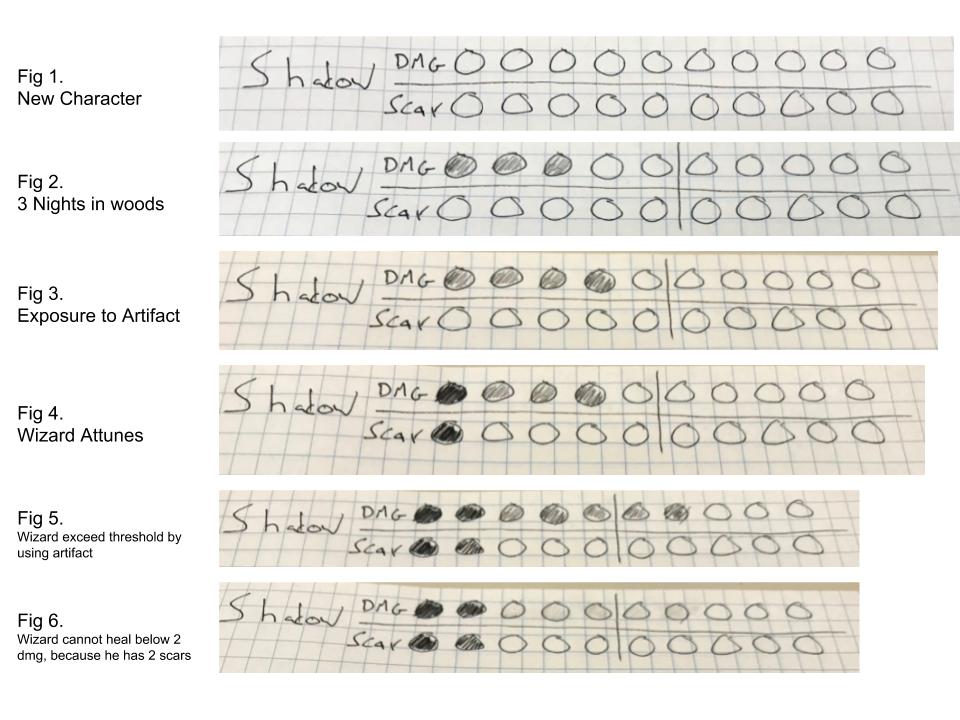
Example: After spending 3 nights in the dark heart of the woods, each character has taken 3 shadow damage. During the morning of the 4th day, the party finally stumbles upon the source of corruption. The harmful radiation of the artifact penetrates their armor, making them feel as if they are freezing, they all take 1 shadow damage immediately bringing them each to 4. The wizard is prepared for this, and throws a specially crafted cloth over the artifact. As soon as it is covered, the adventurers all breathe more easily and the woods around them seem to brighten.

Later, the party takes a short rest and the wizard spends some time meditating with the artifact. His meditations are filled with visions of snow and ice. (The GM does not tell the wizard any specific mechanics about the special abilities of the artifact, only flavor) The wizard decides to attune with the artifact, this gives him one Shadow Scar but does not give him additional shadow damage. 

In the next scene, a rival party of explorers stumbles upon the group. They demand that the artifact be handed over. The wizard exposes the artifact, which is no longer harmful to the group as it has been attuned. He unleashes the power of the artifact on the rival adventurers, despite not knowing what it will do. The GM forces all party members except for the wizard to make constitution saves against the arctic chill, likewise rolling saves for each of the rivals. Those who fail freeze solid (5d10 cold damage), half taken on save. The wizard does not take cold damage, but does take 1d4 shadow damage taking him over his Shadow Threshold. He takes another scar as a result of his Shadow Damage exceeding his Shadow Threshold, and his veins blacken and grow pronounced through his skin as he is now temporarily Shadow Marked. The GM then explains the rules of the artifact ability (all other targets within 60 ft of wizard take 5d10 cold damage, constitution save vs. DC 18 for half.)

The cleric has survived, and rifles through the rival parties gear for the ceremonial herbs that they stole from the group earlier. When he finds them, the group takes a short rest as the cleric cleanses the souls of each surviving party member. The wizard’s black veins fade back to normal after the ritual, but now that he has 2 shadow scars he cannot fully heal. Every party member now has 0 shadow damage, except for the wizard who still has 2 shadow damage.

Shadow Damage


Art cropped from an Eric He image

Forest Crawling

frank hurley chateau-wood-1917

This is a response to:

I’ve been planning a game in the Symbaroum setting. I have been waffling about how to run the forest. I had thought about trying to break it into hexes, but the forest is very large and that seems tedious. The system seems to assume I will be playing it very “trad” and planning each session out ahead of time, but that is not how I prep my games.

I really like running point-crawl one-shots, but I have not thought through about how you might slowly evolve a point-crawl over the length of a campaign. I think that I will have a point crawl map with two main elements, nodes and paths. Both nodes and paths will have a variety of tags, that will have mechanical implications. I want to flesh out some of those implications over a series of blog posts.

To start, paths might simply have the following tags:

  • Rumored Path – Traverse in 1d4x the standard time. 2x Random Encounter chance.
  • Rough Path – Traverse in standard length. 1x Random Encounter chance.
  • Trodden Path – Traverse in half time. 1x Random Encounter chance.

Rumored Paths might be overheard in a tavern, hinted at in a notebook, or sketched on a rough map. Rough Paths would be described by an experienced adventurer, depicted on a detailed map, or shown to the party by a tracker. A trodden path is a commonly known and traveled upon.

Likewise, nodes might have a variety of tags to describe the likelihood of treasure, danger, competition, and corruption. I am still thinking about what number of tags is useful versus just being overkill crunch for something I would be better off not having written down.